Sunday, December 15, 2019

Q2 Week 6 in Review

GRADES K-3 DAILY "BELL WORK" FOR  QUARTER 2 WEEK 7


Vincent van Gogh - The Reaper 

- after Jean-Francois Millet (1889)


Vincent van Gogh - Peasant Woman Binding Sheaves

- after Jean Franacois Millet

After bell work, students use sketchbooks for more extensive, ongoing projects.


All students complete "bell work" at the start of each class before any other instructions are given.  As soon as students are seated, they are to immediately put pencil to paper and begin drawing the image projected before them;  no questions, no comments; no distractions.  

****(Kinder will begin doing bell work near the end of second quarter)

All attention is focused on looking carefully and recording what students SEE.

This is SILENT work time.  Students are working independently, although I often interject with some guidance and state simple parameters.  Students are graded primarily on their efforts and participation, not entirely on the outcome of their drawing.

After drawing, we have a brief class discussion to learn more about the artwork.  We make some guesses at to what the work may be about; what the story may be behind the work.  We THINK about how the artist used line, color, shapes, etc. to communicate meaning and emotion.  We discuss how we may not all respond to the art work in the same way.  

The final step in our Bell Work exercise is to ask ourselves more questions about the art work.  We WONDER what the artist intended to communicate.  This is where Ms. Northway may need to do some research to share what she learned about the artist and her/his life experiences.  

 I typically show students three artworks by the same artist.  In this way, they become familiar with the style of a particular artist, and often can recall the artist's name. All of the children's drawings will be glued into small weekly/bi-weekly books to bring home.


PLEASE KEEP YOUR CHILD'S WEEKLY BOOKS IN A SAFE PLACE (and ordered in a BIG 3 RING BINDER) SO YOU CAN SEE GROWTH THROUGHOUT THE YEAR. 

UPCOMING "BELL WORK" FOR Q2 WEEK 8:

Winslow Homer 
Snap the Whip (1872)
  Winslow Homer 
  West Point, Prout’s Neck (1900)
 Winslow Homer
  Breezing Up - A Fair Wind (1873-1876)


K-3  PROJECTS:  WEEK 7

KINDER

Elements of Art - Shape, Color

This week we began drawing a copy of a Modigliani's portrait on large mixed media paper.  

Students learned some basic proportions of the face.  Specifically, the placement of the eyes,  halfway down the oval of the face. 

 In the coming week, students will be creating a self-portrait but in the style of Amedeo Modigliani, using tempera paint, chalk and oil pastels.


Amedeo Modigliani
Project: Copy of Van Gogh's Sunflowers
Elements of Art - Color, Texture


First graders finished drawing a full page copy of Van Gogh's Sunflowers.  After completing the drawing, they rubbed a thick amount of white oil pastels onto backside the of the paper.  
This is a simple image transfer technique (similar to using carbon or graphite paper).  

This coming week, we will transfer the drawing onto a toned brown paper by tracing over the image layered over the brown paper, to receive the imprint of the sticky oil pastel.  By transferring the drawing this way, we will avoid the problem of any grey pencil lines to dull down the bright yellows and blues of the oil pastels.

GRADE 2

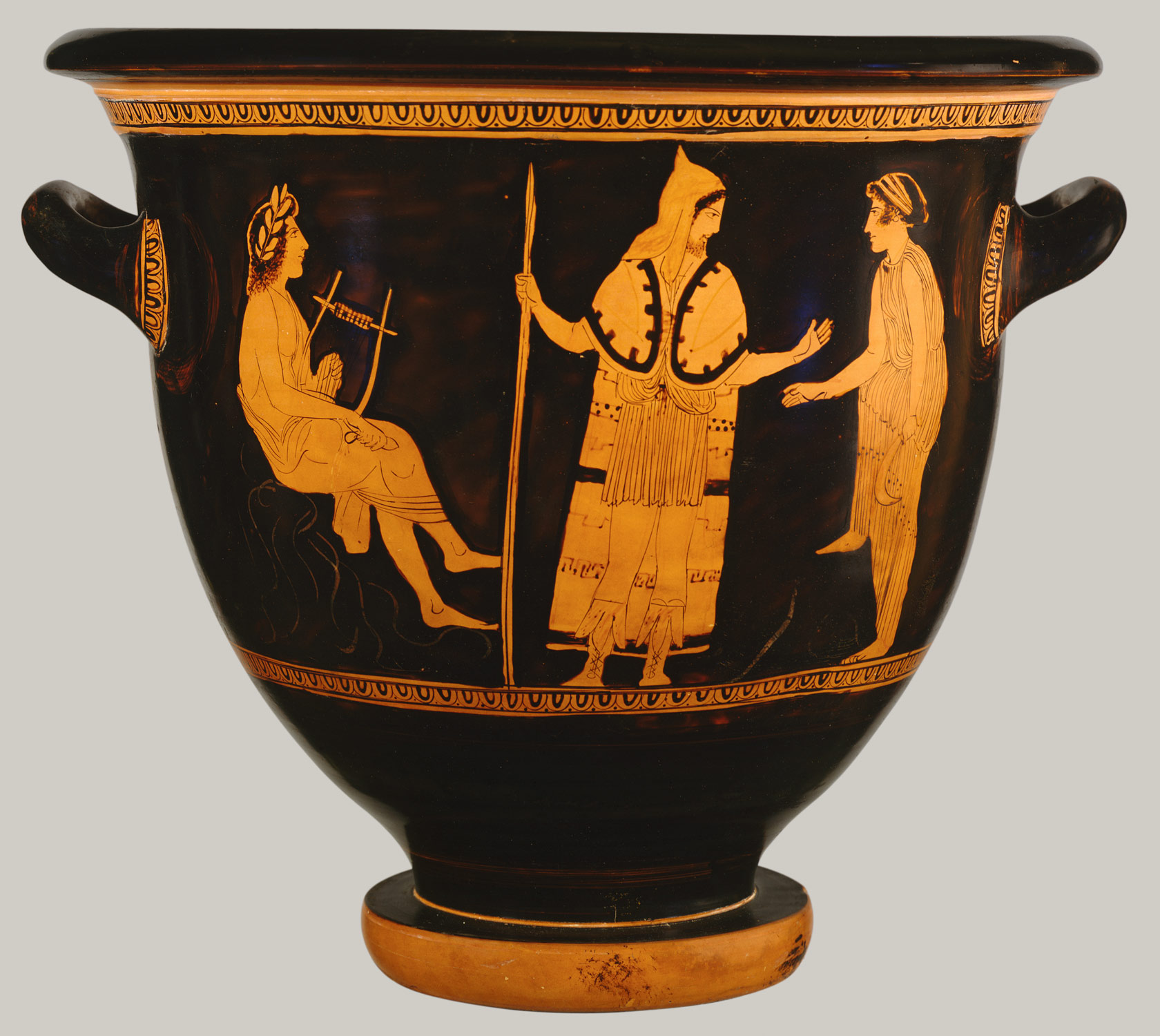
Project: Greek Vessels
Elements of Art - Line, Shape

This past week, students traced their pottery designs with a black grease pencil.  They will continue to add neutral colors with Conté Crayon and then finish by "burnishing" or polishing the surface of the drawing. (The grease pencil will create a shiny surface). 

This project was an opportunity for students to design their own Greek Vessel, while still copying various elements from source imagery of vessels, glued into their sketchbooks.


Pottery aryballos decorated with a deer hunt.  Pottery alabastron decorated with a lion and two griffins.
Corinthian Period of Greek Pottery Design

  https://www.britishmuseum.org/research/collection_online/collection_object_details/collection_image_gallery.aspx?assetId=294566001&objectId=399477&partId=1


 Related image


GRADE 3

Students took a break from their Celtic letter designs to learn how to make quilled snowflake ornaments.  


The ornaments are currently adorning the Christmas trees at the Lower school main entrance, before students take them home this Friday.  


Here are a few fun links for making different types of quilled snowflakes:

Sunday, December 8, 2019

Q2 Week 5 in Review

GRADES K-3 DAILY "BELL WORK" FOR  QUARTER 2 WEEK 6

    Honore Daumier
  A Clown and a Drummer

 Honoré Daumier 
Don Quixote and Sancho Panza

 Honoré Daumier 
Gesture Drawing of Woman Dancing

After bell work, students use sketchbooks for more extensive, ongoing projects.


All students complete "bell work" at the start of each class before any other instructions are given.  As soon as students are seated, they are to immediately put pencil to paper and begin drawing the image projected before them;  no questions, no comments; no distractions.  

****(Kinder will begin doing bell work near the end of second quarter)

All attention is focused on looking carefully and recording what students SEE.

This is SILENT work time.  Students are working independently, although I often interject with some guidance and state simple parameters.  Students are graded primarily on their efforts and participation, not entirely on the outcome of their drawing.

After drawing, we have a brief class discussion to learn more about the artwork.  We make some guesses at to what the work may be about; what the story may be behind the work.  We THINK about how the artist used line, color, shapes, etc. to communicate meaning and emotion.  We discuss how we may not all respond to the art work in the same way.  

The final step in our Bell Work exercise is to ask ourselves more questions about the art work.  We WONDER what the artist intended to communicate.  This is where Ms. Northway may need to do some research to share what she learned about the artist and her/his life experiences.  

 I typically show students three artworks by the same artist.  In this way, they become familiar with the style of a particular artist, and often can recall the artist's name. All of the children's drawings will be glued into small weekly/bi-weekly books to bring home.


PLEASE KEEP YOUR CHILD'S WEEKLY BOOKS IN A SAFE PLACE (and ordered in a BIG 3 RING BINDER) SO YOU CAN SEE GROWTH THROUGHOUT THE YEAR. 

UPCOMING "BELL WORK" FOR Q2 WEEK 7:


Vincent van Gogh - The Reaper 

- after Jean-Francois Millet (1889)


Vincent van Gogh - Peasant Woman Binding Sheaves

- after Jean Franacois Millet


K-3  PROJECTS:  WEEK 6

KINDER

Elements of Art - Shape, Color

This week we began drawing a copy of a Modigliani's portrait in sketchbooks.  In the coming week, students will be creating a self-portrait but in the style of Modigliani.


Amedeo Modigliani
Project: Copy of Van Gogh's Sunflowers
Elements of Art - Color, Texture


GRADE 2

Project: Greek Vessels
Elements of Art - Line, Shape

Students are nearly finished designing their Greek Vessels.  In the coming week, students will add neutral colors with Conté Crayon and then finish tracing over the pencil lines with grease crayons.  

This project was an opportunity for students to design their own Greek Vessel, while still copying various elements from source imagery of vessels, glued into their sketchbooks.


Pottery aryballos decorated with a deer hunt.  Pottery alabastron decorated with a lion and two griffins.
Corinthian Period of Greek Pottery Design

  https://www.britishmuseum.org/research/collection_online/collection_object_details/collection_image_gallery.aspx?assetId=294566001&objectId=399477&partId=1


 Related image


GRADE 3

Students took a break from their Celtic letter designs to learn how to make quilled snowflake ornaments.  This week, the ornaments will be adorning the Christmas trees at the Lower school main entrance.  


Here are a few fun links for making different types of quilled snowflakes:

Thursday, November 14, 2019

Q2 Week 4 in Review

GRADES 1-2 DAILY "BELL WORK" FOR  QUARTER 2 WEEK 4

Caspar David Friedrich

The Grosse Gehege near Dresden


Caspar David Friedrich
Giant Mountains (View of the Small Sturmhaube from Warmbrunn)


Caspar David Friedrich
The Sea of Ice


After bell work, students use sketchbooks for more extensive, ongoing projects.


All students complete "bell work" at the start of each class before any other instructions are given.  As soon as students are seated, they are to immediately put pencil to paper and begin drawing the image projected before them;  no questions, no comments; no distractions.  

****(Kinder will begin doing bell work near the end of second quarter)

All attention is focused on looking carefully and recording what students SEE.

This is SILENT work time.  Students are working independently, although I often interject with some guidance and state simple parameters.  Students are graded primarily on their efforts and participation, not entirely on the outcome of their drawing.

After drawing, we have a brief class discussion to learn more about the artwork.  We make some guesses at to what the work may be about; what the story may be behind the work.  We THINK about how the artist used line, color, shapes, etc. to communicate meaning and emotion.  We discuss how we may not all respond to the art work in the same way.  

The final step in our Bell Work exercise is to ask ourselves more questions about the art work.  We WONDER what the artist intended to communicate.  This is where Ms. Northway may need to do some research to share what she learned about the artist and her/his life experiences.  

 I typically show students three artworks by the same artist.  In this way, they become familiar with the style of a particular artist, and often can recall the artist's name. All of the children's drawings will be glued into small weekly/bi-weekly books to bring home.


PLEASE KEEP YOUR CHILD'S WEEKLY BOOKS IN A SAFE PLACE (and ordered in a BIG 3 RING BINDER) SO YOU CAN SEE GROWTH THROUGHOUT THE YEAR. 

UPCOMING "BELL WORK" FOR Q2 WEEK 5:


Jean-Francis Millet
The Angelus (1857-1859)


Jean-Francis Millet
The Gleaners (1857)

Jean-Francis Millet
The Sower (1850)

K-3  PROJECTS:  WEEK 5


KINDER

Elements of Art - Value, Color

Project: Painted copy of Caspar David Friedrich's Wanderer Above the Sea of Fog


I created a "coloring sheet" of Wanderer Above the Sea of Fog for students to paint.   


For the last few weeks, we have been using tempera paint and learning how to mix values with black and white.  We then progressed to using color with black and white to mix a tint, tone and shade.


Caspar David Friedrich - Wanderer above the sea of fog.jpg

Caspar David Friedrich
Wanderer Above the Sea of Fog
   

FIRST
Elements of Art - Line, Shape

 Project:  The White Shaman Mural - Lower Pecos, Texas 


This week, students copied a small, cropped portion of this rock art mural onto charcoal paper, using soft graphite pencils, Conté Crayon, charcoal pencils and Chalk Pastels.


https://www.youtube.com/watch?v=k4noWkREmVs

https://www.youtube.com/watch?v=-w2uf3JnAl8
https://www.youtube.com/watch?v=NhtX-6MzI_c


Image result for the white shaman


GRADE 2

Project: Greek Vessels


Students began creating their own template of an ancient Greek Vessel.  This beginning phase of copying the outline and shape of the vessel has been painstakingly slow.  The reward for their diligent efforts will be the decorating phase of this project -- drawing griffins, lions and horses onto their Greek vessels. 


Students are learning how to correctly duplicate the correct proportions of the pottery image projected before them, onto their own paper.  (following along with their teacher, step by step). 


This method of enlarging and copying an image of pottery is achieved by learning how to grid their work surface to accurately enlarge the scale -- while keeping the same  proportions.


In the coming week, students will cut out their symmetrical template and trace shape onto good quality paper to decorate with designs inspired by the Corinthian period of Greek pottery. 


Pottery aryballos decorated with a deer hunt.  Pottery alabastron decorated with a lion and two griffins.
  https://www.britishmuseum.org/research/collection_online/collection_object_details/collection_image_gallery.aspx?assetId=294566001&objectId=399477&partId=1


Image result for proto  corinthian griffin pottery


Image result for red figure Related image


GRADE 3

Elements of Art - Line (contour drawing practice); Space (overlapping)


Project:  Celtic Initials - Inspired by the Book of Kells


(Letter T)

Image result for celtic illuminated initial book of kells


(Teacher Demo - Letter C)


All of the students' drawings, or "studies" of ribbons, knots and zoomorphic Celtic animal heads.....are beginning to coalesce into their own Celtic inspired initials.


Thursday, November 7, 2019

Q2 Week 3 in Review

GRADES 1-2 DAILY "BELL WORK" FOR  QUARTER 2, WEEK 3 

Imagery from The Book of Kells:

//


After bell work, students use sketchbooks for more extensive, ongoing projects.


All students complete "bell work" at the start of each class before any other instructions are given.  As soon as students are seated, they are to immediately put pencil to paper and begin drawing the image projected before them;  no questions, no comments; no distractions.  

****(Kinder will begin doing bell work near the end of second quarter)

All attention is focused on looking carefully and recording what students SEE.

This is SILENT work time.  Students are working independently, although I often interject with some guidance and state simple parameters.  Students are graded primarily on their efforts and participation, not entirely on the outcome of their drawing.

After drawing, we have a brief class discussion to learn more about the artwork.  We make some guesses at to what the work may be about; what the story may be behind the work.  We THINK about how the artist used line, color, shapes, etc. to communicate meaning and emotion.  We discuss how we may not all respond to the art work in the same way.  

The final step in our Bell Work exercise is to ask ourselves more questions about the art work.  We WONDER what the artist intended to communicate.  This is where Ms. Northway may need to do some research to share what she learned about the artist and her/his life experiences.  

 I typically show students three artworks by the same artist.  In this way, they become familiar with the style of a particular artist, and often can recall the artist's name. All of the children's drawings will be glued into small weekly/bi-weekly books to bring home.


PLEASE KEEP YOUR CHILD'S WEEKLY BOOKS IN A SAFE PLACE (and ordered in a BIG 3 RING BINDER) SO YOU CAN SEE GROWTH THROUGHOUT THE YEAR. 

UPCOMING "BELL WORK" FOR WEEK 3 Q2

K-3  PROJECTS:  WEEK 2


Caspar David Friedrich


The Grosse Gehege near Dresden


Caspar David Friedrich

The Sea of Ice  


Caspar David Friedrich

Giant Mountains (View of the Small Sturmhaube from Warmbrunn)

KINDER

Project: Painting practice and mixing light, medium and dark values (tempera paint) 

Element of Art - Value


FIRST

Continuous Line Drawings: Pablo Picasso 
Elements of Art - Line


In a follow-up to the continuous line drawings of animals by Picasso, students will be learning how to do an upside down drawing.

No, I will not ask your children to stand on their heads to complete this task!
 Instead, I will show them an image of each of the drawings above by slowly revealing the drawing from under a piece of paper.  The drawing will be turned upside down, and slowly revealed as students draw, not knowing what it is they are drawing until the image is complete and paper turned right side up.  

This is an old drawing exercise that has been around many years.  

Think of your child when they were toddlers and how he/she may have thought it fun to bend at the waist......in their diapers...... and look at the world from an upside down point of view.  
It's never a bad idea to learn to look at things from a new angle/perspective; taking a slower, more contemplative look.  


GRADE 2

Project: Greek Vessels

Students began creating their own template of an ancient Greek Vessel.  This beginning phase of copying the outline and shape of the vessel has been painstakingly slow.  The reward for their diligent efforts will be the decorating phase of this project -- drawing griffins, lions and horses onto their Greek vessels. 

Students are learning how to correctly duplicate the correct proportions of the pottery image projected before them, onto their own paper.  (following along with their teacher, step by step). 

This method of enlarging and copying an image of pottery is achieved by learning how to grid their work surface to accurately enlarge the scale -- while keeping the same  proportions.

In the coming week, students will cut out their symmetrical template and trace shape onto good quality paper to decorate with designs inspired by the Corinthian period of Greek pottery. 

Pottery aryballos decorated with a deer hunt.  Pottery alabastron decorated with a lion and two griffins.
  https://www.britishmuseum.org/research/collection_online/collection_object_details/collection_image_gallery.aspx?assetId=294566001&objectId=399477&partId=1

Image result for proto  corinthian griffin pottery


Image result for red figure Related image


GRADE 3

Elements of Art - Line (contour drawing practice); Space (overlapping)

Project:  Celtic Initials - Inspired by the Book of Kells


(Letter T)

Image result for celtic illuminated initial book of kells


(Teacher Demo - Letter C)


All of the students' drawings, or "studies" of ribbons, knots and zoomorphic Celtic animal heads.....are beginning to coalesce into their own Celtic inspired initials.

This week, students began drawing a meandering ribbon  attached to a stylized animal head, twisting and turning around the first initial to their name.


As students worked, I prompted them to refer back to their previous drawing studies and handouts in their sketchbooks.  


In the coming weeks, students will copy their completed sketch and then COPY AGAIN onto a good quality, toned tan mixed media paper. 


THE PRINCIPLES OF DESIGN - HOW WE ORGANIZE ART and LIFE

Wk 10 VIDEO Link As we all have been spending much more time at home, you may have also spent a little more time organizing your living sp...